
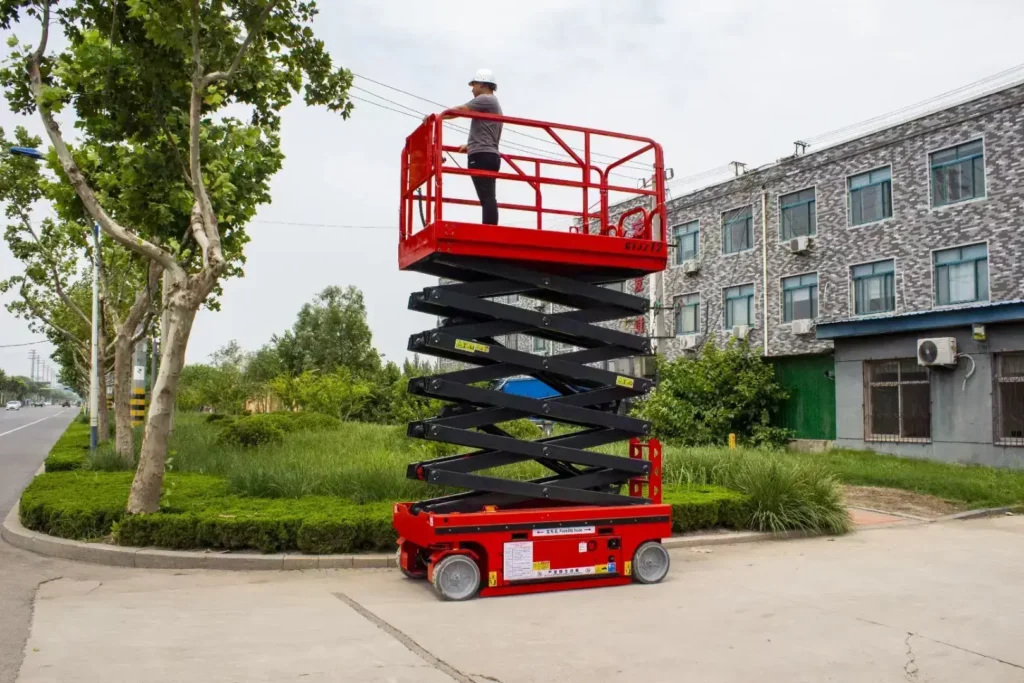
Selecting the appropriate mobile elevating work platform requires a precise mathematical understanding of jobsite weight requirements. Evaluating total scissor lift load capacity involves calculating combined worker weights, heavy power tools, raw materials, and extended platform deck distribution. Overlooking rated weight thresholds risks triggering automatic overload cutouts or compromising machine stability during high-reach elevation.
Contractors, facility managers, and equipment rental providers must balance platform dimensions with structural weight limits. Modern electric and rough-terrain platforms feature sophisticated overload sensor systems designed to prevent lift operation when safe payload thresholds are breached. Understanding how manufacturers engineer these weight boundaries ensures both jobsite safety and optimal operational productivity.
In this technical engineering guide, we examine standard weight ratings across height classes, calculate extension deck capacity limitations, break down occupant distribution rules, and provide a systematic methodology to calculate the ideal scissor lift load capacity for your application.
Table of Contents
- What Is Scissor Lift Load Capacity and Why It Matters
- Standard Scissor Lift Load Capacity Rating Matrix
- Main Platform vs. Extension Deck Load Capacity
- The Physics of Platform Overload and Stability Curves
- How to Calculate Total Jobsite Payload (Workers + Tools + Materials)
- Sensors and Load-Sensing Systems under ANSI Standards
- Matching Load Capacity to Specific Industry Applications
- Frequently Asked Questions (FAQ)
- Conclusion and Fleet Selection Next Steps
What Is Scissor Lift Load Capacity and Why It Matters
Technically defined, scissor lift load capacity represents the maximum allowable gross weight—including personnel, safety harnesses, hand tools, hydraulic equipment, and building materials—that a platform can safely elevate to its maximum working height.
Manufacturers determine rated workload ratings through rigorous structural strain testing and hydraulic pressure limits. Exceeding specified rated capacity compromises the structural integrity of the scissor arm stack, accelerates hydraulic component wear, and violates international occupational health and safety regulations.
Standard Scissor Lift Load Capacity Rating Matrix
Weight limits vary significantly depending on whether the machine is an ultra-compact slab electric lift or a high-reach rough-terrain unit. Review typical industry baseline standards below:
| Machine Height Class | Working Height | Typical Scissor Lift Load Capacity | Max Occupants (Indoor / Outdoor) | Extension Deck Capacity Limit |
|---|---|---|---|---|
| 6m Micro Slab | 6.0 m (19 ft) | 230 kg (507 lbs) | 2 / 1 Person | 100 kg (220 lbs) |
| 8m Standard Slab | 8.0 m (26 ft) | 230 kg – 320 kg | 2 / 1 Person | 113 kg (250 lbs) |
| 10m Medium Elevation | 10.0 m (32 ft) | 320 kg – 450 kg | 2 / 2 Persons | 113 kg (250 lbs) |
| 12m High-Bay Slab | 12.0 m (39 ft) | 320 kg – 450 kg | 2 / 1 Person | 113 kg (250 lbs) |
| 14m Heavy-Duty | 14.0 m (45 ft) | 350 kg (770 lbs) | 2 / 1 Person | 120 kg (265 lbs) |
| 16m Maximum Reach | 16.0 m (52 ft) | 200 kg – 350 kg | 2 / 1 Person | 113 kg (250 lbs) |
| Rough-Terrain Diesel/Electric | 12m – 18m (39–59 ft) | 450 kg – 680 kg (1000+ lbs) | 4 / 2 Persons | 150 kg – 227 kg |
For detailed elevation metrics across these height brackets, consult our complete scissor lift working height guide, and review operational machinery costs in our electric scissor lift price guide.
Main Platform vs. Extension Deck Load Capacity
A frequent operational mistake on job sites is assuming the extension deck holds the same weight rating as the main platform center. In reality, modern mobile elevating work platforms feature dual-zone weight ratings.
While a 10m machine may boast a total scissor lift load capacity of $320 \text{ kg}$, the extended roll-out deck section is typically restricted to $113 \text{ kg}$ to $120 \text{ kg}$. The extended platform acts as a cantilever beam, increasing tipping torque on the chassis base:
$$\text{Torque} = \text{Force} \times \text{Distance}$$
Placing excessive weight at the far edge of the extension deck multiplies structural bending moment on the scissor pins. Always distribute heavy toolboxes and bulk materials directly over the main chassis center, reserving the slide-out deck primarily for personnel access.
The Physics of Platform Overload and Stability Curves
Engineering a high-capacity aerial platform requires balancing gravity centers, scissor arm thickness, hydraulic system pressure, and dynamic side forces. When evaluating rated scissor lift load capacity, engineers calculate static stability and dynamic wind load forces.
Static tipping angle calculations rely on maintaining the center of gravity ($\text{CG}$) within the tipping lines of the wheel footprint. The relationship between total elevated mass ($M$), platform elevation height ($h$), and base chassis weight ($W_b$) determines the maximum allowable payload:
$$M_{\text{max}} = \frac{W_b \times b}{2 \times h \times \tan(\theta)}$$
Where $b$ represents chassis track width and $\theta$ is maximum permitted slope angle. This engineering balance explains why heavy rough-terrain lifts require wide outriggers to support a $680 \text{ kg}$ scissor lift load capacity at extended heights.
How to Calculate Total Jobsite Payload (Workers + Tools + Materials)
To avoid triggering safety alarms or breaching safety codes, fleet managers should enforce a strict payload estimation process before elevating personnel.
A practical jobsite calculation model includes:
- Personnel Weight Standard: Under international standards, each worker is calculated at a standardized minimum weight of $80 \text{ kg}$ ($176 \text{ lbs}$) including basic clothing.
- Personal Protective Equipment (PPE): Fall arrest harnesses, lanyards, and hard hats add roughly $10 \text{ kg}$ per worker.
- Tools and Hand Equipment: Cordless drills, impact drivers, wire spools, and utility boxes average $25 \text{ kg} – 50 \text{ kg}$.
- Installed Materials: Conduit, HVAC ducting, plumbing pipes, or drywall sheets represent the largest variable payload weight.
Sample Calculation: Two electricians ($160 \text{ kg}$) + gear ($20 \text{ kg}$) + conduit bundles ($90 \text{ kg}$) = $270 \text{ kg}$ total required load. This job requires a platform with a minimum rated scissor lift load capacity of $320 \text{ kg}$.
Sensors and Load-Sensing Systems under ANSI Standards
Modern mobile elevating work platforms manufactured under updated safety standards incorporate active electronic load-sensing systems (LSS). Pressure transducers installed on lift cylinder pins continuously measure platform mass.
Key safety mechanism triggers governed by global design rules include:
- Visual & Audible Alarm Trigger: When elevated payload reaches 90% to 100% of maximum rated scissor lift load capacity, warning lights flash and an audible alarm sounds.
- Motion Cutout Functionality: If payload exceeds 100% to 110% of rated capacity, the control system disables drive and lift functions until the overload is removed.
- Compliance Authorities: Active load sensing design rules are established globally by ANSI A92.20 standards in North America and validated internationally under IPAF (International Powered Access Federation) safety guidelines.
Matching Load Capacity to Specific Industry Applications
Different commercial industries demand distinct platform loading characteristics:
- Indoor Electrical & Facility Maintenance: A 6m or 8m slab lift with $230 \text{ kg}$ capacity provides adequate support for one technician and electrical testing gear.
- HVAC & Ductwork Installation: Requires a minimum 10m or 12m platform offering $320 \text{ kg} – 450 \text{ kg}$ capacity to accommodate two workers and heavy steel duct sections simultaneously.
- Steel Erection & Rough-Terrain Construction: Demands heavy-duty rough terrain platforms providing $450 \text{ kg} – 680 \text{ kg}$ capacity to support multiple ironworkers and heavy welding gear across unpaved ground.
For specialized site requirements, compare terrain mobility in our crawler vs wheeled scissor lift guide, review battery system options in our scissor lift battery guide, optimize indoor logistics in our warehouse scissor lift guide, or evaluate drive mechanics in our self-propelled vs mobile scissor lift guide.
If you plan to import machinery directly from factory hubs, review export logistics in our step-by-step guide on how to import scissor lifts from China and inspect container loading density in our scissor lift container loading guide.
Frequently Asked Questions (FAQ)
Q1: What happens if you exceed the rated scissor lift load capacity?
Exceeding rated capacity triggers automatic overload sensors that disable lift and drive functions. In older unmonitored machines, overloading creates severe tipping hazards, structural pin deformation, and hydraulic pump failure.
Q2: Does extension deck weight count toward total scissor lift load capacity?
Yes. The total scissor lift load capacity includes everything on both the main platform and the extension deck combined. Furthermore, the extension deck itself has a separate lower individual limit (typically 113 kg).
Q3: How many workers can safely occupy a scissor lift at once?
Occupant limits depend on machine specification labels and indoor/outdoor rating settings. Standard slab lifts generally permit 2 occupants indoors and 1 occupant outdoors due to wind stability regulations.
Q4: How do wind loads affect scissor lift load capacity ratings outdoors?
Wind force exerts lateral side pressure on the platform. Outdoor ratings lower allowable worker occupancy or total capacity to compensate for wind force pushing against elevated platform surfaces.
Conclusion and Fleet Selection Next Steps
Selecting the correct scissor lift load capacity is essential for maintaining site productivity, compliance with ANSI/EN safety standards, and long-term equipment durability. Factoring in worker weight, heavy tools, extended deck limits, and dynamic jobsite environments guarantees safe aerial operations.
Ready to select the ideal elevated platform for your equipment fleet? Explore our broad selection of electric scissor lifts for sale or browse our master product directory of aerial lift for sale to request instant technical datasheets and competitive factory quotes today.