
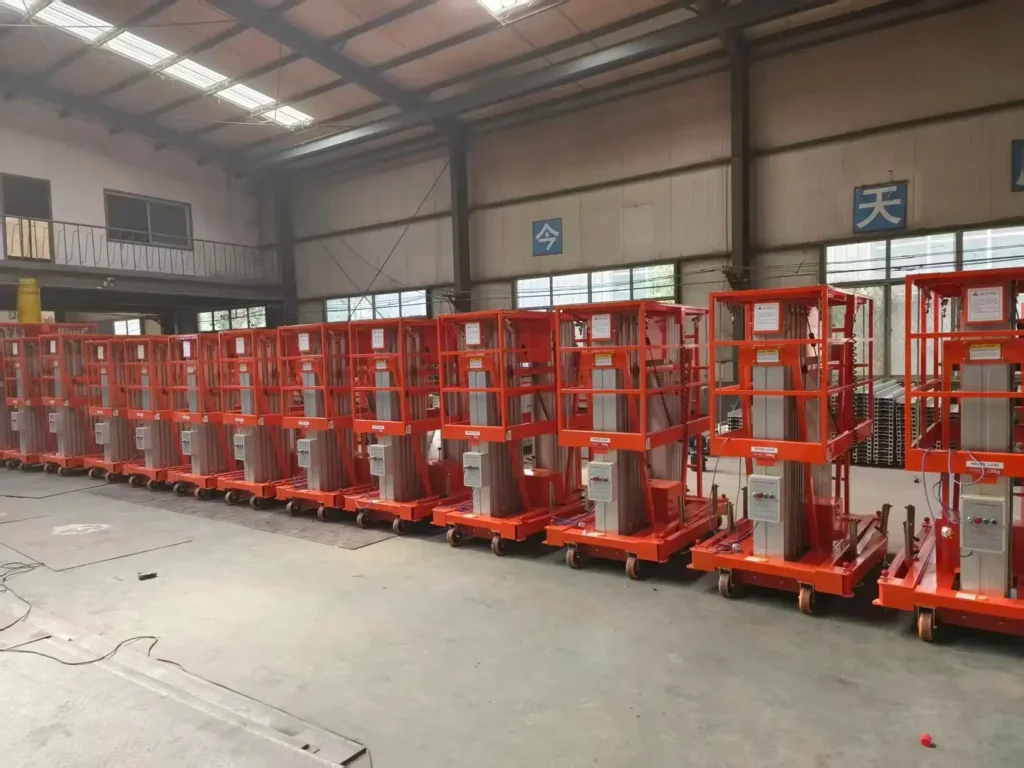
Unlike heavy steel scissor lifts, vertical mast lifts feature high-strength aluminum alloy telescoping masts mounted on ultra-compact base chassis. These specialized mobile elevating work platforms easily fit inside standard passenger elevators, pass through narrow single doorways, and operate smoothly on tile, marble, or raised computer access floors without exceeding structural ground pressure thresholds.
In this comprehensive equipment guide, we analyze single vs. dual mast designs, working height coverage, power source options, maintenance requirements, and direct factory procurement strategies for our commercial lineup of aluminum vertical mast lifts for sale.
Table of Contents
- What Is an Aluminum Vertical Mast Lift and How Does It Work?
- Single Mast vs. Dual Mast Lifts: Technical Comparison
- Aluminum Vertical Mast Lift Specification & Height Matrix
- Primary Advantages of Lightweight Aluminum Aerial Platforms
- Engineering Innovations: Battery Power & Drive Configurations
- Target Industry Applications and Jobsite Use Cases
- International Safety Standards and Load Sensor Compliance
- Frequently Asked Questions (FAQ)
- Conclusion and Direct Procurement Next Steps
What Is an Aluminum Vertical Mast Lift and How Does It Work?
An aluminum vertical mast lift is a specialized aerial work platform engineered with interlocking, high-tensile aluminum alloy extruded columns. These telescoping mast sections raise straight up vertically via hydraulic cylinders or heavy-duty leaf chains, providing stable elevation with minimal structural weight.
Contractors inspecting commercial inventory of aluminum vertical mast lifts for sale immediately notice their compact transport footprint. Designed primarily for vertical ascent without horizontal outreach, these machines deliver high maneuverability in zero-inside-turning-radius environments like retail aisles, airport terminals, and data centers.
Single Mast vs. Dual Mast Lifts: Technical Comparison
Understanding the distinction between single-column and double-column configurations is critical when evaluating premium aluminum vertical mast lifts for sale for your fleet.
- Single Mast Lifts: Designed for single-operator maintenance tasks. Featuring an ultra-slender chassis width (often under 0.8 meters), these units easily glide through standard office doors. They offer platform load capacities ranging from $120 \text{ kg}$ to $150 \text{ kg}$, making them ideal for light fixture replacement and HVAC inspections.
- Dual Mast Lifts: Incorporate two parallel interlocking aluminum mast columns for superior structural rigidity. Dual-mast models support elevated platform payloads up to $200 \text{ kg} – 300 \text{ kg}$, accommodating two technicians along with tools and installation materials while maintaining a remarkably low overall machine weight.
Aluminum Vertical Mast Lift Specification & Height Matrix
Review standardized performance metrics across our commercial inventory of aluminum vertical mast lifts for sale below:
| Mast Type Class | Working Height | Platform Height | Lift Capacity | Machine Weight Range | Overall Stowed Width |
|---|---|---|---|---|---|
| Single Mast 6m | 6.0 m (19.6 ft) | 4.0 m | 125 kg (275 lbs) | 320 kg – 380 kg | 0.74 m (29 in) |
| Single Mast 8m | 8.0 m (26.2 ft) | 6.0 m | 125 kg (275 lbs) | 390 kg – 450 kg | 0.76 m (30 in) |
| Single Mast 10m | 10.0 m (32.8 ft) | 8.0 m | 120 kg (265 lbs) | 460 kg – 520 kg | 0.80 m (31.5 in) |
| Dual Mast 10m | 10.0 m (32.8 ft) | 8.0 m | 200 kg (440 lbs) | 620 kg – 680 kg | 0.90 m (35.4 in) |
| Dual Mast 12m | 12.0 m (39.4 ft) | 10.0 m | 200 kg (440 lbs) | 720 kg – 780 kg | 1.00 m (39.3 in) |
| Dual Mast 14m Heavy | 14.0 m (45.9 ft) | 12.0 m | 150 kg (330 lbs) | 820 kg – 890 kg | 1.15 m (45.2 in) |
To cross-reference vertical reach limits with scissors and boom designs, check our scissor lift working height guide, and review structural payload limitations in our scissor lift load capacity guide.
Primary Advantages of Lightweight Aluminum Aerial Platforms
Buyers who invest in certified aluminum vertical mast lifts for sale gain substantial operational advantages over conventional steel scissor structures:
- Low Ground Pressure: Operating weights starting as low as $320 \text{ kg}$ prevent structural flooring damage in historic buildings, museums, sports arenas, and raised-floor server rooms.
- Elevator and Doorway Accessibility: Stowed heights under 2.0 meters and narrow widths allow seamless transit through standard single doorways and freight or passenger elevators.
- Non-Marking Tires & Outriggers: Standard non-marking polyurethane tires and rubber outrigger pads leave zero skid marks on polished epoxy, wood, or tile floors.
- Ease of Transport: Compact single-mast units can be loaded onto light pickup trucks or small trailers using manual tilt-back accessories or forklift pockets.
Engineering Innovations: Battery Power & Drive Configurations
Modern commercial offerings of aluminum vertical mast lifts for sale feature highly flexible drive and power options tailored to diverse indoor work environments.
Equipment buyers can choose between two main drive formats:
- Push-Around (Manual Transit, Electric Lift): Ultra-lightweight models where operators manually push the machine into position before deploying stabilizing outriggers and engaging the electric hydraulic lift pump via AC power or a 12V DC battery.
- Self-Propelled Electric Drive: Fully motorized units powered by 24V deep-cycle lead-acid or lithium battery systems. Operators can drive, steer, and elevate the machine directly from the platform upper controller.
Upgrading to maintenance-free lithium battery options extends operational runtimes and supports fast opportunity charging. For a complete analysis of battery chemistry upgrades, review our scissor lift battery guide. To compare pricing metrics against steel slab platforms, explore our electric scissor lift price guide.
Target Industry Applications and Jobsite Use Cases
Because of their non-destructive ground weight and precision maneuverability, our selection of aluminum vertical mast lifts for sale serves a wide array of commercial sectors:
- Commercial Real Estate & Facility Management: Routine light bulb replacement, ceiling tile repairs, sprinkler testing, and HVAC vent cleaning in high-rise office lobbies.
- Warehousing & Order Picking: Narrow-aisle inventory stock picking and rack inspection in logistics hubs. For heavy-duty warehouse applications, compare models outlined in our warehouse scissor lift guide.
- Auditoriums, Schools & Hotels: Overhead maintenance over carpeted or decorative marble flooring where heavy machinery is strictly prohibited.
- Industrial Plant Maintenance: Compact overhead access between dense machinery lines where traditional self-propelled scissor lifts cannot maneuver. See drive mechanics in our self-propelled vs mobile scissor lift guide.
International Safety Standards and Load Sensor Compliance
Operating elevated platforms demands rigorous adherence to international engineering standards. Every model in our inventory of aluminum vertical mast lifts for sale is built to comply with strict global safety mandates.
Key safety systems integrated into modern mast platforms include:
- Automatic Outrigger Interlocks: On push-around models, electronic sensors prevent platform elevation unless all four stabilizing outriggers are properly deployed and leveled on the ground.
- Emergency Descent Valves: Manual pull-valves allow safe platform lowering from ground level in the event of primary electrical power loss.
- Overload & Tilt Monitoring: Compliance standards mandated in North America by ANSI A92.20 standards enforce automatic platform load sensing and inclination tilt cutouts. Operational guidelines are further supported by IPAF (International Powered Access Federation) safety regulations.
If you plan to import equipment directly from international factories, consult our step-by-step tutorial on how to import scissor lifts from China and inspect freight packing rules in our scissor lift container loading guide. For off-road terrain alternatives, review our crawler vs wheeled scissor lift guide.
Frequently Asked Questions (FAQ)
Q1: What is the main difference between an electric scissor lift and an aluminum vertical mast lift?
Vertical mast lifts utilize lightweight aluminum telescoping columns, resulting in a much lighter total weight (300kg–700kg) ideal for delicate floors. Scissor lifts use heavy steel pantograph arms, providing higher weight capacity but much heavier machine weight (1100kg+).
Q2: Can aluminum vertical mast lifts fit into standard passenger elevators?
Yes. Single-mast aluminum lifts are specifically designed with compact footprints (under 0.8m wide and under 2.0m stowed height) and low total weights to safely fit inside standard commercial passenger and freight elevators.
Q3: Do push-around aluminum mast lifts require outriggers to elevate?
Yes. Push-around aluminum vertical mast lifts rely on plug-in stabilizing outriggers to broaden the base footprint. Interlock safety sensors prevent the platform from elevating until all outriggers are locked securely.
Q4: What is the average lifting capacity of an aluminum vertical mast lift?
Single-mast models typically have a rated lift capacity of 120 kg to 150 kg (1 person + tools). Dual-mast models feature higher capacities ranging from 200 kg to 300 kg (2 persons + tools).
Conclusion and Direct Procurement Next Steps
Selecting certified aluminum vertical mast lifts for sale provides facility managers and contractors with the ideal balance of low machine weight, compact elevator accessibility, and safe vertical elevation. By choosing between single and dual mast configurations, your team guarantees maximum jobsite efficiency while protecting delicate interior flooring.
Ready to upgrade your maintenance fleet with high-quality, lightweight mast platforms? Explore our core product category page for aluminum vertical mast lifts for sale, check our full catalog of electric scissor lifts for sale, or browse our master listing of aerial lift for sale to request instant pricing and technical datasheets today.