
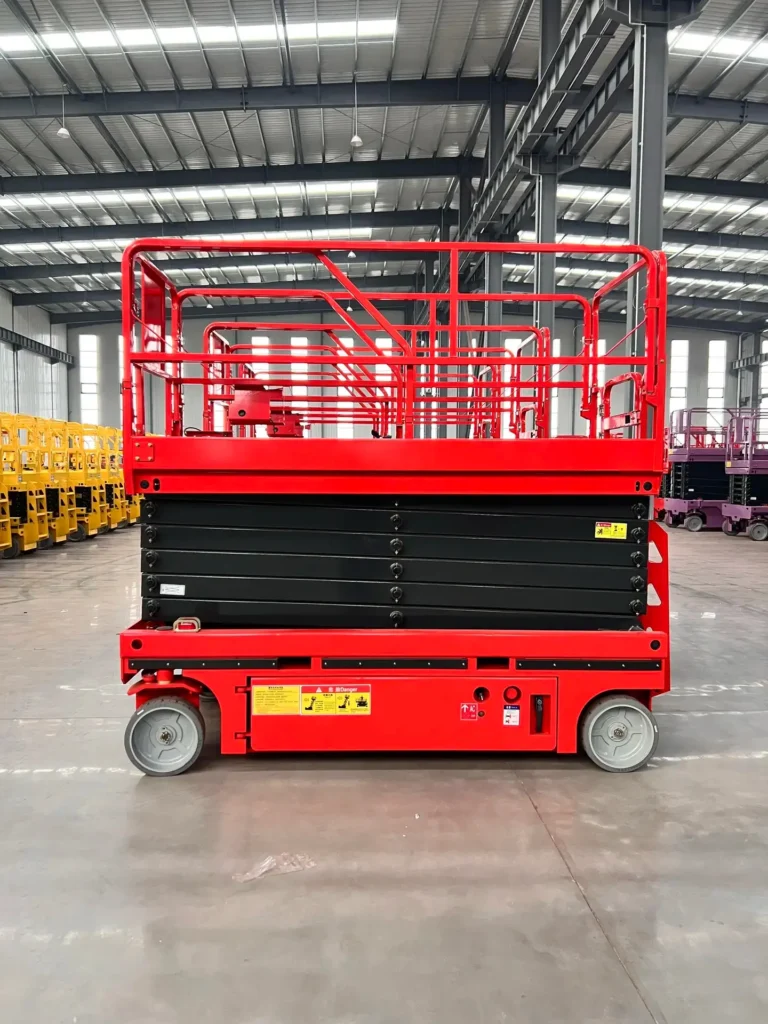
Self propelled vs mobile scissor lift is a common comparison for contractors, maintenance teams, warehouses, factories, rental companies, and industrial buyers. Both configurations provide vertical access, but they are designed around different operating priorities.
A self-propelled scissor lift combines lifting and travel functions in one machine. A mobile hydraulic scissor lift is generally selected when the work position is more fixed and the buyer prioritizes lifting performance, platform capacity, or a heavy-duty configuration. The exact specification varies by model, so buyers should compare the technical data rather than relying on the product category alone.
This guide compares mobility, productivity, platform capacity, working environment, transport, maintenance, rental use, and total purchasing considerations. The goal is to help you choose the machine that fits the actual jobsite instead of choosing only by price or maximum height.
The self propelled vs mobile scissor lift decision should always begin with the work that the machine needs to perform. Consider how often the machine moves, how much weight must be carried, how high the platform needs to reach, and what conditions exist at the jobsite.
Table of Contents
- Self Propelled vs Mobile Scissor Lift: Quick Answer
- What Is a Self-Propelled Scissor Lift?
- What Is a Mobile Hydraulic Scissor Lift?
- Self Propelled vs Mobile Scissor Lift: 7 Key Differences
- 1. Mobility and Repositioning
- 2. Productivity and Work Efficiency
- 3. Platform Capacity and Working Load
- 4. Indoor and Outdoor Applications
- 5. Ground Conditions and Site Access
- 6. Transport and Storage
- 7. Maintenance and Long-Term Operation
- Comparison Table
- When Should You Choose a Self-Propelled Scissor Lift?
- When Should You Choose a Mobile Hydraulic Scissor Lift?
- Which Is Better for Rental Fleets?
- Which Is Better for Warehouses and Factories?
- What Should You Ask the Manufacturer?
- Common Buying Mistakes to Avoid
- Final Recommendation
- Frequently Asked Questions
Self Propelled vs Mobile Scissor Lift: Quick Answer
In the self propelled vs mobile scissor lift comparison, neither configuration is automatically better for every buyer.
Choose a self-propelled machine when the equipment needs to move between multiple work areas during a project. This is often relevant to warehouses, factories, commercial facilities, and maintenance operations where repositioning time affects productivity.
Choose a mobile hydraulic machine when the equipment is mainly used in one work position and the project places greater emphasis on platform capacity, heavy-duty structure, or a specific lifting configuration.
| Your Main Requirement | Recommended Starting Point |
|---|---|
| Frequent movement between work areas | Self-propelled scissor lift |
| Large warehouse maintenance | Self-propelled scissor lift |
| Factory work across multiple areas | Self-propelled scissor lift |
| Fixed-position installation | Mobile hydraulic scissor lift |
| High platform capacity requirements | Compare high-capacity models |
| Low repositioning frequency | Mobile hydraulic may be suitable |
| Mixed rental demand | Consider a fleet with both types |
The final decision should also consider working height, platform capacity, platform size, machine width, lowered height, floor conditions, transport requirements, and the exact model specification.
What Is a Self-Propelled Scissor Lift?
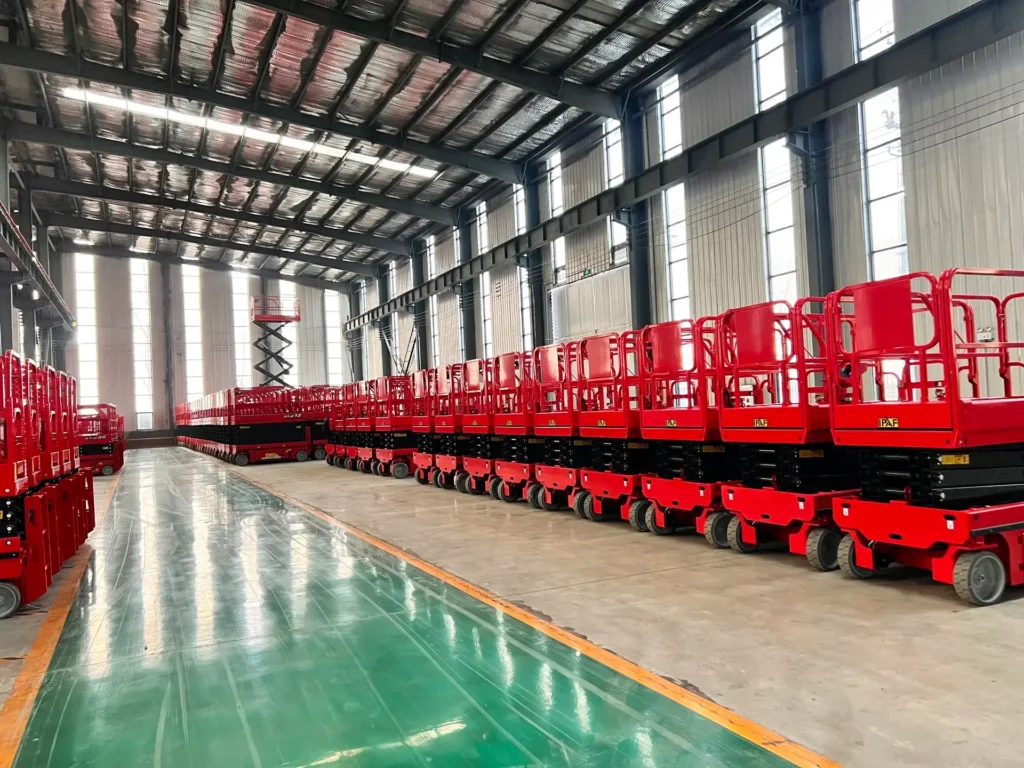
A self-propelled scissor lift is a mobile elevating work platform with an integrated drive and steering system. Depending on the model and operating conditions, the machine can travel under its own power, allowing operators to reposition the equipment between suitable work areas.
Typical applications include warehouse maintenance, factory services, lighting work, electrical installation, mechanical maintenance, and commercial facility management.
The main advantage is mobility. When the machine must be repositioned many times in one day, integrated travel can reduce setup time and improve workflow.
For example, a maintenance team working across a large warehouse may need to access multiple lighting fixtures, cable trays, ventilation systems, or equipment points. In this situation, the ability to move the platform between work areas can be valuable.
A self-propelled machine is not automatically the best option for every task. Buyers still need to check working height, load capacity, platform dimensions, travel limitations, battery requirements, and site conditions.
What Is a Mobile Hydraulic Scissor Lift?
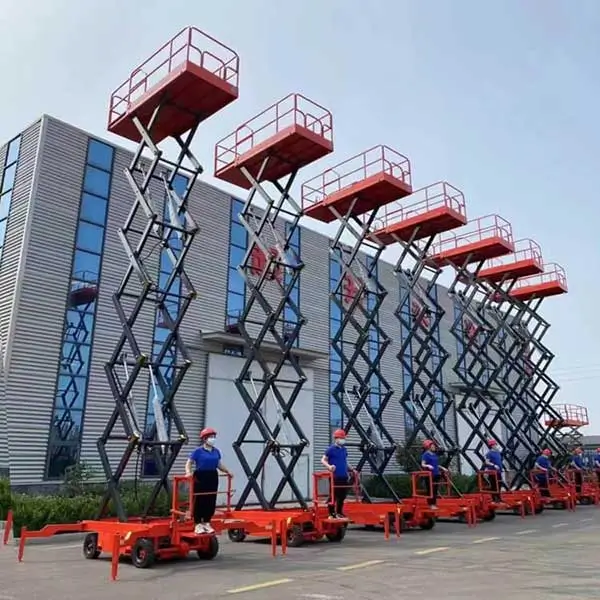
A mobile hydraulic scissor lift is generally selected for vertical lifting where the work position is more fixed. Depending on the design, the machine may be repositioned manually or with suitable handling equipment rather than relying on an integrated travel system.
This configuration can be attractive for industrial installation, heavy maintenance, and applications that require a larger or higher-capacity working platform.
Potential applications include:
- Industrial equipment installation
- Heavy maintenance
- Large component installation
- Factory projects
- Fixed-position construction support
- High-capacity elevated work
The most important point is that mobile hydraulic machines do not all have the same capacity or movement method. Buyers should review the exact machine specification, including lifting capacity, platform size, stabilizing system, transport dimensions, and repositioning method.
The self propelled vs mobile scissor lift choice should therefore be based on the actual machine configuration, not simply on the category name.
DADE® Machinery provides both self-propelled and mobile hydraulic scissor lift solutions. Buyers can review the DADE® electric scissor lift product range and compare the available configurations with their application requirements.
Self Propelled vs Mobile Scissor Lift: 7 Key Differences
1. Mobility and Repositioning
The biggest difference in the self propelled vs mobile scissor lift comparison is how the machine moves between work locations.
A self-propelled machine integrates travel functions into the equipment. This can be useful when operators need to move from one task to another without repeatedly arranging separate handling equipment.
A mobile hydraulic machine may be better suited to projects where the work area remains concentrated in one location.
Ask one practical question: How many times will the machine move during a normal working day?
If the answer is ten, twenty, or more repositioning movements, self-propelled equipment may provide a meaningful productivity advantage. If the machine stays in one position for hours at a time, integrated travel may be less important.
2. Productivity and Work Efficiency
Productivity is closely connected to repositioning time, which is why the self propelled vs mobile scissor lift decision should be based on workflow rather than brochure specifications alone.
In a large warehouse, a maintenance contractor may need to work at several locations. The time spent lowering, moving, setting up, and repositioning equipment can add up over the course of a project.
A self-propelled configuration can reduce some of this non-productive time when operated within the manufacturer’s specified limits and site conditions.
A mobile hydraulic machine can still be highly productive when the work itself is concentrated in one location. In that situation, platform size, capacity, and lifting performance may create more value than travel speed.
3. Platform Capacity and Working Load
Platform capacity is one of the most important specifications to compare in a self propelled vs mobile scissor lift purchase decision.
Calculate the combined weight of:
- Operators
- Tools
- Materials
- Installation components
- Equipment carried on the platform
Do not assume that a self-propelled machine always has lower capacity or that a mobile hydraulic machine always has higher capacity. The actual rated capacity depends on the specific model.
Also confirm whether the quoted capacity applies to the entire platform, an extension deck, or a particular operating position.
If your work requires several workers and heavy materials, a high-capacity model may be more important than travel capability.
If your work mainly involves one or two operators with tools and frequent movement, a self-propelled configuration may provide a better balance.
4. Indoor and Outdoor Applications
The working environment can change the answer to the self propelled vs mobile scissor lift question.
For indoor applications, self-propelled electric machines are often considered where users need to move through aisles, production areas, or commercial facilities.
Important factors include:
- Machine width
- Turning radius
- Non-marking tires
- Lowered height
- Battery runtime
- Charging requirements
- Floor condition
Mobile hydraulic machines can also be suitable indoors when the work position is more fixed and the platform needs to support a specific installation task.
For outdoor applications, buyers should examine ground conditions, slopes, surface quality, wind exposure, tire configuration, and the manufacturer’s operating limitations.
The correct machine type depends on the actual environment rather than whether the project is simply labeled indoor or outdoor.
5. Ground Conditions and Site Access
Ground conditions should be reviewed before buying any scissor lift.
Check:
- Floor or ground surface
- Levelness
- Load-bearing capacity
- Ramps
- Slopes
- Travel routes
- Obstacles
- Clearance
A self-propelled machine can be very convenient on suitable level surfaces, but it should not be assumed to be appropriate for rough terrain unless the specific model is designed for those conditions.
The travel route should also be checked before delivery. Measure doors, gates, aisles, ramps, turning areas, and other restrictions.
A machine that has the correct working height may still be unsuitable if it cannot reach the work area safely.
IPAF’s MEWP selection guidance highlights the importance of considering working height, reach, task requirements, materials and tools, environment, restrictions, access, terrain, and delivery when selecting equipment. Read the IPAF MEWP selection checklist for additional planning guidance.
6. Transport and Storage
Transport is another important part of the self propelled vs mobile scissor lift comparison.
Before placing an order, request:
- Overall length
- Overall width
- Lowered height
- Machine weight
- Packaging dimensions
- Container loading information
- Unloading requirements
Self-propelled machines can have different dimensions and weights because of their drive and steering systems. Mobile hydraulic machines may have different packaging and handling requirements.
For international buyers, shipping dimensions can affect container utilization and total landed cost.
This is why the equipment specification and logistics plan should be reviewed together.
For a broader discussion of purchase cost, options, and shipping, read the Electric Scissor Lift Price Guide.
7. Maintenance and Long-Term Operation
Maintenance requirements depend on machine design, component quality, operating hours, and service practices.
A self-propelled machine may include additional drive, steering, control, and battery systems. A mobile hydraulic machine may place more emphasis on its hydraulic lifting system and structural components.
Neither category automatically has a lower lifetime maintenance cost.
Before buying, ask:
- Which components are used?
- What routine maintenance is required?
- Are spare parts available?
- Are hydraulic and electrical diagrams supplied?
- What warranty is provided?
- How quickly can replacement parts be delivered?
- Is technical support available after delivery?
For rental fleets, serviceability and parts availability can be especially important because machines may operate frequently across different sites.
Self Propelled vs Mobile Scissor Lift Comparison Table
| Factor | Self-Propelled Scissor Lift | Mobile Hydraulic Scissor Lift |
|---|---|---|
| Travel | Integrated drive and steering on applicable models | Repositioning method depends on model |
| Frequent movement | Strong advantage | Less suitable when repositioning is constant |
| Warehouse maintenance | Often a good fit | Suitable for more fixed tasks |
| Factory maintenance | Useful for multiple work areas | Useful for fixed installation areas |
| Platform capacity | Model-dependent | Model-dependent; compare exact ratings |
| Heavy installation | Depends on rated capacity | Can be attractive for high-capacity applications |
| Transport | Check weight and dimensions | Check weight, dimensions, and handling requirements |
| Best fit | Frequent repositioning and multi-point work | Fixed-position or specialized lifting tasks |
The self propelled vs mobile scissor lift comparison becomes clearer when the same machine specifications are placed side by side. Always compare working height, platform capacity, dimensions, battery, drive system, warranty, and shipping terms before making a purchasing decision.
When Should You Choose a Self-Propelled Scissor Lift?
Choose a self-propelled machine when the work requires frequent repositioning.
It is a strong starting point when:
- The facility is large
- Workers move between multiple tasks
- The machine may be repositioned many times per day
- Warehouse maintenance is common
- Factory maintenance covers multiple areas
- The rental fleet needs versatile equipment
- Travel productivity matters
For example, a distribution center may require regular access to lights, ventilation, cables, and overhead equipment across many aisles. In that case, mobility can have a direct effect on project efficiency.
The self propelled vs mobile scissor lift decision is therefore often a workflow decision. If travel is part of the job, integrated mobility can be valuable.
When Should You Choose a Mobile Hydraulic Scissor Lift?
Choose a mobile hydraulic configuration when the machine will mainly operate in one position and the project prioritizes lifting performance or capacity.
It may be suitable when:
- The working position changes infrequently
- The platform must carry heavier loads
- The installation task is concentrated in one location
- A larger work platform is required
- Mobility is less important than lifting performance
- The machine will be positioned with suitable handling equipment
For example, an industrial installation project may require workers to remain at one location for an extended period while installing equipment or structural components.
In this case, the self propelled vs mobile scissor lift question may be answered by the required platform capacity and project workflow rather than travel requirements.
Which Is Better for Rental Fleets?
For rental companies, the self propelled vs mobile scissor lift decision should be based on the most common customer applications rather than the lowest factory price.
Self-propelled equipment may be attractive for:
- Warehouses
- Factories
- Commercial buildings
- Maintenance contractors
- Installation companies
- Large indoor projects
Mobile hydraulic models may serve customers who need higher-capacity or more fixed-position lifting applications.
A mixed fleet may be the best solution if customer demand covers both use cases.
Before buying, review:
- Typical working height
- Average rental duration
- Customer application
- Platform capacity
- Transport requirements
- Maintenance cost
- Parts availability
- Resale value
The goal is to maximize fleet utilization rather than purchasing the largest possible machine.
Which Is Better for Warehouses and Factories?
In warehouse and factory purchasing, the self propelled vs mobile scissor lift decision often depends on the size of the facility and how often the machine must move.
Self-propelled electric machines can be useful when maintenance teams need to travel between multiple work areas.
Check:
- Aisle width
- Door width
- Door height
- Turning space
- Floor conditions
- Ramp gradients
- Storage area
A machine that can reach the required height but cannot move through the facility is not a practical choice.
For the correct working height, review the Scissor Lift Working Height Guide and compare the actual platform height and working height of each model.
What Should You Ask the Manufacturer?
When comparing the self propelled vs mobile scissor lift options, request both technical and commercial information.
Product Specifications
- Working height
- Platform height
- Platform capacity
- Platform dimensions
- Machine width
- Lowered height
- Machine weight
- Drive system
- Steering system
- Battery and charger
- Hydraulic system
Operating Conditions
- Indoor or outdoor use
- Maximum slope
- Ground requirements
- Travel limitations
- Wind limitations
- Operating temperature
Commercial Information
- Unit price
- Packaging cost
- Shipping dimensions
- Container loading quantity
- Lead time
- Warranty
- Spare parts
- After-sales support
For a direct factory quotation, provide your required working height, platform capacity, application, expected movement frequency, quantity, destination port, and customization requirements.
DADE® Machinery’s product range can be reviewed through its aerial work platform product page before sending a detailed inquiry.
Common Buying Mistakes to Avoid
Choosing Only by Price
Two machines can have very different specifications. Compare the same working height, capacity, platform size, battery system, and included options.
Choosing the Tallest Machine
More height is not always better. Excessive height can increase cost, weight, transport requirements, and storage needs.
Ignoring Repositioning Frequency
If the machine moves many times per day, mobility can have a major effect on productivity.
Ignoring Site Access
Measure doors, aisles, gates, ramps, and turning areas before ordering.
Ignoring Total Landed Cost
International buyers should consider packaging, freight, customs, and local delivery in addition to the machine price.
Ignoring After-Sales Support
Spare parts and technical support can strongly affect uptime and long-term ownership value.
Final Recommendation
The self propelled vs mobile scissor lift decision should be based on the actual jobsite, not on price alone.
Choose self-propelled equipment when frequent movement, warehouse access, factory maintenance, and multi-point work are priorities.
Choose mobile hydraulic equipment when the work is more stationary and the application places greater emphasis on platform capacity, heavy-duty lifting, or a specific installation configuration.
Before purchasing, compare:
- Working height
- Platform height
- Platform capacity
- Platform dimensions
- Machine width
- Lowered height
- Mobility requirements
- Ground conditions
- Transport dimensions
- Maintenance support
- Warranty
- Spare parts
The right machine is the one that matches the work process, environment, and required performance.
For international buyers, DADE® Machinery provides electric self-propelled and mobile hydraulic scissor lift solutions. Review the product range and provide the factory with your required height, capacity, application, quantity, and destination.
Frequently Asked Questions
What is the main difference between a self-propelled and mobile scissor lift?
The main difference is the way the machine is repositioned. Self-propelled models have integrated travel functions on applicable designs, while mobile hydraulic models use a different repositioning method depending on the machine. The exact specification should always be confirmed with the manufacturer.
Is a self-propelled scissor lift better than a mobile hydraulic model?
Neither is universally better. Self-propelled equipment is generally more attractive for frequent repositioning, while mobile hydraulic equipment can be a better fit for fixed-position or high-capacity lifting tasks.
Which approach is better for a self propelled vs mobile scissor lift purchase?
The best approach is to compare the exact technical specifications of two or more models designed for the same application. Review working height, platform capacity, platform size, machine dimensions, mobility, battery, warranty, spare parts, and shipping terms.
Which scissor lift is better for warehouses?
A self-propelled electric model can be a practical choice for warehouses where operators need to move between multiple work areas. Buyers should check aisle width, floor conditions, machine dimensions, working height, and platform capacity.
Which type is better for heavy installation?
A mobile hydraulic model may be worth considering when the work is concentrated in one location and the application requires a high-capacity platform. Compare the exact capacity and dimensions of the individual models.
Are self-propelled scissor lifts more expensive?
The price depends on the complete specification. Drive and steering systems, battery configuration, working height, platform capacity, and optional features can all affect the final quotation.
Can a self-propelled scissor lift be used outdoors?
Some models are designed for outdoor conditions, while others are intended mainly for indoor use. Always check the manufacturer’s specifications for ground conditions, slope, tires, wind limits, and other operating restrictions.
Which type is better for a rental company?
There is no universal answer. Self-propelled models can be versatile for frequent repositioning, while mobile hydraulic models can serve customers with specialized high-capacity needs. A mixed fleet may be appropriate for businesses with diverse customer demand.
What information should I send when requesting a quotation?
Provide working height, platform capacity, application, indoor or outdoor use, expected movement frequency, quantity, destination port, and customization requirements. Complete information allows the manufacturer to recommend a more suitable configuration.
How do I compare two scissor lifts accurately?
Compare the same working height, platform capacity, platform dimensions, battery system, drive configuration, transport dimensions, warranty, spare parts support, and shipping terms. Do not compare unit price alone.
Why is the self propelled vs mobile scissor lift comparison important?
The comparison helps buyers match the equipment configuration to the actual workflow. Frequent repositioning, fixed-position installation, platform capacity, site access, and transport requirements can all lead to different purchasing decisions.
For additional workplace safety information, review the official OSHA Scissor Lift Safety Guidance.